How Salon POS Tracks Retail Product & Inventory Sales in the UAE
August 3, 2026
Best Restaurant POS Features UAE F&B Owners Should Look For
August 5, 2026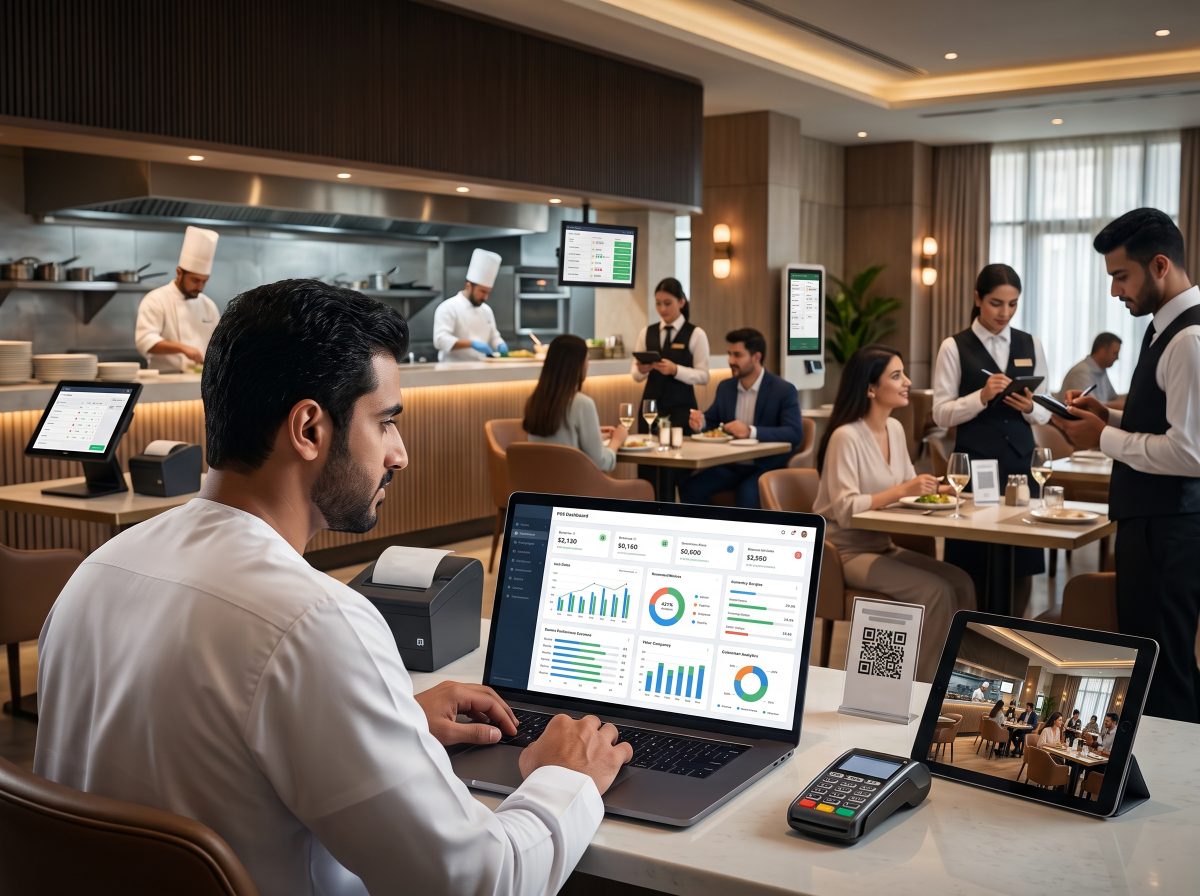
Running a restaurant in the UAE today means juggling dine-in orders, delivery apps, VAT invoicing and staff schedules, often across more than one branch. It’s no surprise that a growing number of restaurant owners are moving away from traditional, on-premise billing counters and adopting a cloud-based restaurant POS system instead. The shift isn’t just about convenience. It’s about being able to see what’s happening in the business at any given moment, from any location, without waiting for someone to compile an end-of-day report.
This change is happening quietly across Dubai, Abu Dhabi and Sharjah, but the reasons behind it are consistent. Restaurant owners want visibility, speed and control, and a cloud dashboard delivers all three in one place.
Table of Contents
What Is a Cloud-Based POS Dashboard?
A cloud POS dashboard is essentially the control centre of a restaurant’s point-of-sale system. Instead of storing sales, inventory and staff data on a single in-store server, everything is synced to the cloud and made accessible through any internet-connected device. An owner in Abu Dhabi can check sales from a Dubai outlet on their phone during a commute, without calling the branch manager for numbers.
The dashboard itself typically pulls together several functions that used to sit in separate spreadsheets or standalone reports: daily revenue, item-level sales, staff clock-in records, table turnover and stock movement. Having these in one interface means an owner spends less time chasing numbers from different sources and more time acting on them. For a business with tight staffing and multiple moving parts, that consolidation alone often justifies the switch.
Why UAE Restaurants Are Making the Switch
Several operational pressures are pushing UAE restaurant owners toward cloud dashboards rather than legacy, server-based billing setups:
- Multi-branch growth – Many UAE restaurant groups now operate across two or more Emirates, and a single dashboard makes it possible to compare branch performance side by side.
- Rising delivery volumes – With aggregator apps and in-house delivery both common, owners need a way to track order sources without switching between systems.
- Staff turnover – Cloud systems let managers onboard new staff faster since the interface and reporting stay consistent across every terminal.
- Remote oversight – Owners who split time between properties, or travel frequently, need reporting that doesn’t depend on being physically on-site.
- Rising rent and margins pressure – Tighter margins mean owners want daily, not monthly, visibility into food cost and wastage trends.
Real-Time Visibility Across Every Branch
One of the biggest draws of a cloud dashboard is the ability to monitor multiple outlets from a single screen. Sales figures, table turnover, void transactions and stock levels update live, rather than being reconciled overnight. This matters in a market like the UAE, where a restaurant group might run a central kitchen supplying several smaller outlets, or manage a mix of dine-in and delivery-only locations.
Because everything runs on synced infrastructure, owners aren’t dependent on a physical server sitting in one location. A properly configured cloud IT setup also means data isn’t lost if a single outlet has a power cut or hardware failure, since records are already stored off-site.
This kind of setup also changes how quickly problems get noticed. If one branch’s sales dip sharply during what should be a busy lunch service, a manager checking the dashboard from another site can flag it and call ahead, instead of finding out days later when the weekly report is compiled.
VAT Compliance and Secure Data Handling
VAT compliance remains a non-negotiable requirement for every restaurant operating in the UAE, and cloud dashboards make this considerably easier to manage. Invoices generated with the correct TRN details are stored centrally, so pulling records for an FTA audit doesn’t mean digging through separate systems at each branch. Encrypted, cloud-stored transaction data also reduces the risk that comes with keeping sensitive customer and payment information on a single local device.
This becomes especially useful at month-end, when reconciling sales against bank settlements and supplier invoices usually eats up hours of admin time. A dashboard that connects directly to accounting software removes most of that manual matching, since figures flow through automatically instead of being re-entered by hand. For multi-branch groups, this also means one consolidated VAT return instead of stitching together numbers from separate outlets.
Better Decisions Through Live Reporting
Traditional POS systems often generate reports only at the end of the day or week, by which point slow-moving stock or a pricing issue has already cost money. A cloud dashboard changes that by surfacing patterns as they happen, such as which dishes are underperforming at a given time of day, how individual staff members are trending on upselling, or where ingredient usage is running ahead of the expected food cost percentage. Owners who track this data consistently, rather than reactively, tend to catch small issues, like a supplier price change eating into margins, well before they show up in the monthly numbers.
This kind of reporting is also useful for managing customer loyalty and repeat visits. Linking sales data with a CRM tool makes it easier to see which promotions actually bring diners back, rather than guessing based on gut feel.
Cloud Dashboards and the Rise of Delivery-First Formats
The UAE’s food scene has seen fast growth in cloud kitchens, delivery-only brands and hybrid dine-in formats. These models depend heavily on accurate, real-time order tracking, since a single kitchen may be fulfilling orders for several virtual brands at once. A connected digital ordering setup allows all of this to route through one dashboard, rather than staff manually checking multiple tablets and apps during service.
For owners running these formats, the value shows up most clearly during peak hours. When aggregator orders, in-house delivery and walk-in customers all hit the kitchen at once, a single dashboard view of order status prevents tickets from getting lost or duplicated. It also makes it easier to spot which delivery platform is actually driving profitable volume, rather than just the highest order count.
What to Look for in a Cloud POS Dashboard
Not every cloud system offers the same depth of reporting. Restaurant owners evaluating a switch should look for:
- Live, branch-level sales and inventory reporting
- Built-in VAT-compliant invoicing
- Offline mode that syncs automatically once connectivity returns
- Role-based access so staff only see what’s relevant to them
- Integration with delivery platforms and accounting tools
A dashboard that covers these basics gives an owner a genuinely useful daily tool, not just a fancier way to view sales totals. It’s worth testing these features with real order volumes during a trial period, since a dashboard that looks clean with sample data can behave very differently once it’s handling a full dinner rush across three branches at once.
Restaurant owners who have made this switch typically describe it as a shift from reacting to problems to spotting them early. Providers like iTudeTech have built their restaurant POS systems specifically around this kind of real-time, cloud-first reporting, which is part of why the shift has gathered pace across the UAE’s food service sector over the past few years.
Conclusion
Cloud-based POS dashboards are becoming the standard for UAE restaurants for practical reasons: better visibility, easier VAT compliance, and reporting that reflects what’s happening today, not last week. As delivery, cloud kitchens and multi-branch operations continue to grow across the Emirates, owners who move to cloud dashboards are simply better positioned to manage margins and make faster decisions than those still relying on end-of-day paperwork.
Frequently Asked Questions
1. What is a cloud-based POS dashboard?
It’s a centralised, internet-accessible view of a restaurant’s sales, inventory and staff data, updated in real time.
2. Is a cloud POS system safe for storing customer payment data?
Yes, reputable cloud POS providers use encrypted storage and transmission to protect transaction and customer data.
3. Can a cloud POS dashboard work without internet access?
Most modern systems include an offline mode that keeps recording sales locally and syncs once connectivity returns.
4. Do cloud POS dashboards help with UAE VAT compliance?
Yes, they generate TRN-compliant invoices and store records centrally, making FTA audits easier to manage.
5. Is switching to a cloud POS dashboard expensive for small restaurants?
Most cloud POS systems are subscription-based, which usually costs less upfront than maintaining on-premise servers.