How Salon POS Collects & Manages Customer Reviews in UAE
July 31, 2026
Why UAE Restaurant Owners Are Switching to Cloud-Based POS Systems
August 4, 2026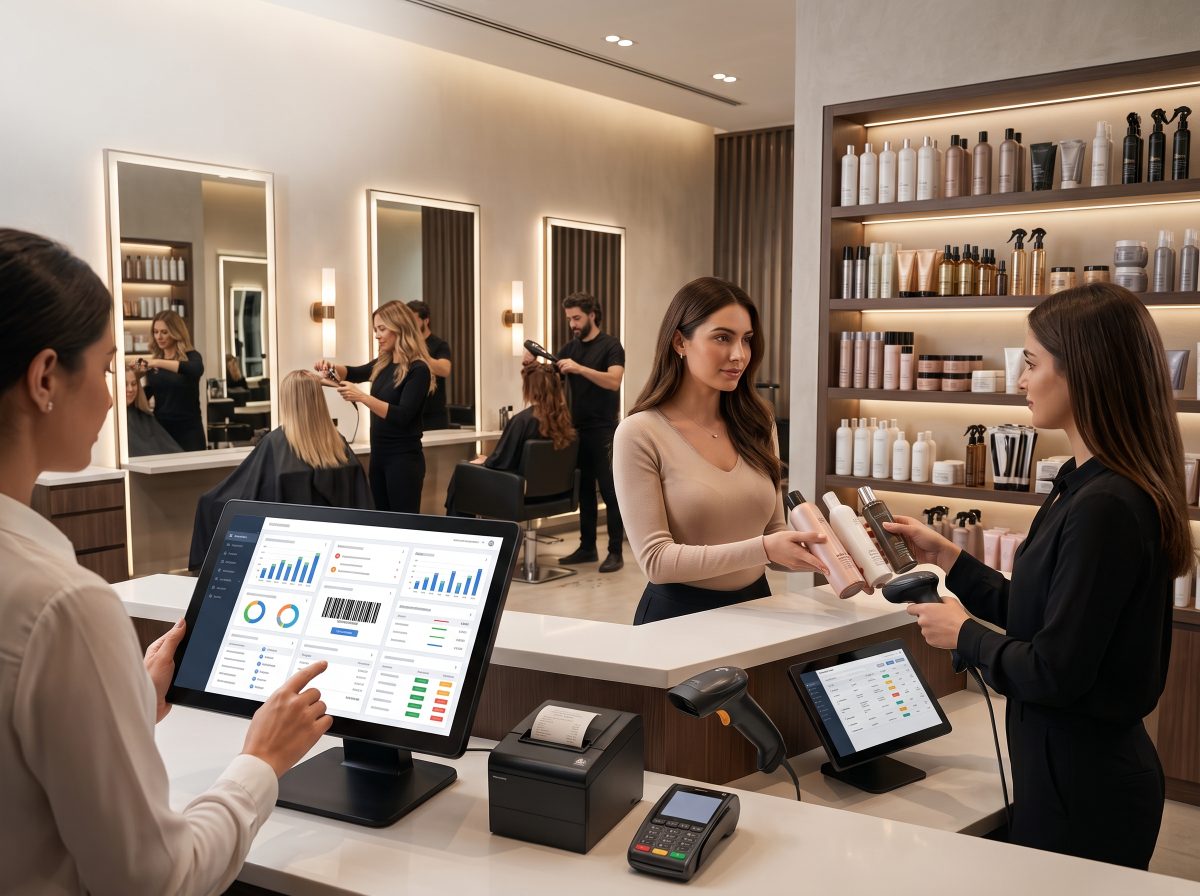
Walk into any busy salon in Dubai or Sharjah on a Saturday afternoon and you’ll see two revenue streams running side by side: services on the chair and retail products at the counter. A client gets a keratin treatment, then walks out with the same shampoo the stylist used on her hair. That second sale is easy to lose track of on paper or through a generic till that treats every transaction the same way. A dedicated salon POS system is built to capture both transactions the moment they happen, tying every bottle sold back to stock levels, staff commission, and VAT reporting. This piece breaks down exactly how that tracking works, why the retail side of a salon deserves its own reporting lane, and what owners should look for before trusting a system with their shelves.
Table of Contents
Why Retail Sales Tracking Matters for UAE Salons
Retail add-ons, shampoos, serums, wax kits, styling tools, even branded merchandise, often carry higher margins than services, but only if the numbers are actually tracked with any discipline. Manual counting or spreadsheet updates almost always lag behind real sales, which means the numbers owners see are already outdated by the time they act on them.
- Stock discrepancies go unnoticed until a shelf is already empty
- Front-desk staff can’t tell clients what’s genuinely in stock right now
- Owners can’t see which products actually drive profit versus which ones just sit there
- VAT reporting becomes a guessing game at month-end instead of a clean export
A connected system removes most of this guesswork by logging every unit sold against live inventory the instant checkout happens, rather than waiting for someone to reconcile a notebook at closing time.
How Salon POS Logs and Separates Retail Sales in Real Time
When a product is scanned or selected at checkout, the software deducts it from stock automatically and records the sale under a distinct retail category, separate from service revenue. This separation is one of the most important design decisions in salon software, because mixing the two makes it nearly impossible to see which side of the business is actually carrying the month.
Barcode scanning speeds this process up further. Instead of a staff member manually searching a product list while a client waits, a quick scan pulls the item, price, and available quantity, then updates the ledger before the receipt even prints. For salons running a hair salon POS setup, this same logic extends naturally to bundled retail kits sold alongside blowouts or color treatments, so a bundled sale still splits correctly into its retail and service components.
With that separation in place, owners get a clearer daily picture:
- Total service revenue for the day, week, or month
- Total retail product revenue over the same period
- Which staff members are consistently driving product upsells
- Which categories — haircare, skincare, or tools — sell fastest and which barely move
Reports built this way help owners set realistic retail targets for staff without guessing based on gut feel or a rough end-of-month glance at the register.
Automated Stock Alerts and Reorder Triggers
Running out of a bestselling serum mid-week is a lost sale that’s entirely preventable, yet it happens constantly in salons relying on manual stock checks. Inventory-aware POS platforms flag low stock automatically, based on thresholds the owner sets per product, so nobody finds out about a shortage from an annoyed client.
This is especially useful for multi-location groups, where stock can quietly run low at one branch while sitting unused at another just a few kilometres away.
- Low-stock alerts trigger before shelves actually run empty
- Reorder quantities can be pre-set per supplier to save admin time
- Transfer requests between branches happen without a round of phone calls
- Seasonal products, like holiday gift sets, get flagged before demand actually spikes
This kind of automation matters even more for salons managing several outlets, a challenge covered in more depth in the guide on multi-branch salon POS software.
Keeping Retail Sales VAT-Compliant
Every retail product sold in the UAE carries VAT obligations that need to be recorded accurately and separately from service tax lines, since the two are treated differently in reporting. A system that logs retail sales at the point of purchase makes it far simpler to generate VAT-ready reports without reconciling registers by hand at month-end or chasing down missing receipts.
For a deeper look at how this works specifically for salon billing, the piece on VAT billing in salon POS software covers the compliance side in more detail, including how service and product VAT lines are typically structured on a single invoice.
Turning Inventory Data Into Smarter Merchandising
Beyond day-to-day stock control, historical sales data reveals patterns that are easy to miss otherwise: which products sell best right after specific services, which months see spikes in retail demand, and which items barely move off the shelf no matter how they’re displayed.
Salons that review this data monthly tend to make sharper decisions on what to restock, what to discount, and what to phase out entirely rather than carrying dead stock for months out of habit. Loyalty-linked purchases add another layer here too — clients who redeem points on retail products often reveal buying patterns worth building promotions around, a connection explored further in the article on loyalty programs for UAE salons.
What to Look for Before Choosing a System
Not every POS platform handles retail tracking with the same level of detail, so it’s worth checking a few things before committing:
- Does it separate retail and service revenue automatically, or does that require manual tagging?
- Can stock thresholds be set per product rather than store-wide?
- Does it support multi-branch stock visibility if you plan to expand?
- Are VAT reports generated automatically or do they need manual adjustment?
Getting clear answers on these points upfront saves a lot of frustration later, especially once a salon starts carrying dozens of retail SKUs.
Where iTudeTech Fits In
Salons across the UAE, from single-chair studios to multi-branch chains rely on iTudeTech‘s point-of-sale platform to keep retail and service revenue cleanly separated, stock levels accurate, and VAT reporting audit-ready without extra manual work. The system is built specifically around the day-to-day realities of UAE salons, not adapted from a generic retail template, which is part of why inventory tracking stays reliable even during peak hours when a busy front desk has no time to double-check numbers by hand.
Conclusion
Retail product sales are too easy to undercount when they’re tracked separately from the till or logged by hand at the end of a long day. A salon POS system that ties every product sale directly to live inventory removes that blind spot, giving owners accurate margins, fewer stockouts, and VAT reports that hold up to scrutiny. For salons juggling both services and retail counters, that visibility is often the difference between guessing and actually knowing where the profit comes from.
Frequently Asked Questions
1. Does salon POS track retail sales separately from service sales?
Yes, retail and service revenue are logged under separate categories for accurate reporting.
2. Can the system alert me when a product is running low?
Yes, low-stock alerts trigger automatically based on thresholds you set per product.
3. How does barcode scanning help with inventory accuracy?
It updates stock counts instantly at checkout, removing manual counting errors.
4. Is retail product VAT handled differently from service VAT?
Retail VAT is logged separately at the point of sale, simplifying compliance reporting.
5. Can multi-branch salons track inventory across locations?
Yes, stock levels and transfer requests can be monitored across all branches in one dashboard.